Relationships and Timing
Start here for love readings, commitment questions, and situations where sequence or status matters.
Browse every hexagram in the Book of Changes with full English interpretation and translation. Each page includes the judgment, all six line readings, and practical interpretation for love, career, and health.
Looking for a specific hexagram meaning? Start with these interpretation paths for relationships, self-cultivation, change, and inner truth before browsing the full list.
Start here for love readings, commitment questions, and situations where sequence or status matters.
Useful when the question is about support, learning, habits, emotional nutrition, or trustworthy guidance.
Browse these pages for turning points, strategic withdrawal, and periods where change must be timed carefully.
Each hexagram in the I Ching (also written Yi Jing or Yi King) is a stack of six horizontal lines — solid (yang, ⚊) or broken (yin, ⚋). The bottom three lines form the lower trigram and the top three form the upper trigram. Together they describe a moment in time and the energetic pattern moving through it.
To interpret a reading, work through the page in this order:
Casting a hexagram is traditionally done with 50 yarrow stalks or three coins. Each toss generates one line, from bottom to top, until six lines complete the hexagram. The I Ching app faithfully reproduces the yarrow-stalk method digitally.
Every hexagram is built from two of the eight elemental trigrams. Knowing their attributes makes any hexagram readable at a glance.
Creative, strong, initiating. Father.
Receptive, yielding, nurturing. Mother.
Arousing, sudden movement. Eldest son.
Abysmal, danger, flowing through risk. Middle son.
Keeping still, stopping, boundary. Youngest son.
Gentle, penetrating, influence over time. Eldest daughter.
Clinging, clarity, illumination. Middle daughter.
Joyous, open, exchange. Youngest daughter.
When you read a hexagram, ask what these two elements do together. For example, water below thunder is Hexagram 3 (Zhūn) — Difficulty at the Beginning; mountain above earth is Hexagram 23 (Bō) — Splitting Apart.
A hexagram is a figure of six stacked lines used in the I Ching. Each line is either solid (yang) or broken (yin). The 64 possible combinations describe every situation life can present. Each hexagram has a name, a judgment, an image, and six individual line readings.
Two methods are traditional. The yarrow-stalk method uses 50 stalks and four ritualised divisions per line; it takes about 20 minutes. The three-coin method tosses three coins six times — heads count 3, tails count 2 — totals of 6, 7, 8, or 9 give the line type and whether it is changing. The I Ching app reproduces both digitally.
A changing line is a line that is "in motion" — it is in the process of turning into its opposite (yang → yin, or yin → yang). Changing lines have their own short reading. They also transform the original hexagram into a second hexagram, which describes the next phase of the situation.
All three refer to the same Chinese classic, 易經 (Book of Changes). "I Ching" is the older Wade–Giles romanization, "Yi Jing" is modern Pinyin, and "Yi King" is the traditional French rendering. We use them interchangeably across this site.
Open the page of the hexagram you cast and read the Judgment and image first. Then read each changing line for specific guidance, and map the overall energy onto your question. For a love reading the upper trigram often describes the other person and the lower trigram yourself; for a career reading, upper is the outer situation (company, market) and lower is your inner state.
The I Ching is not a fortune-telling device that "predicts" outcomes. It is a 3,000-year-old system for reflecting on a situation through 64 symbolic patterns. Its accuracy is the accuracy of the reflection it provokes — questions usually answer themselves once the right pattern is named.
Our interpretations draw on the classical Chinese text together with Richard Wilhelm's German translation (rendered into English) and the original Japanese commentary. Each individual hexagram page links to the original line text and the Wilhelm-tradition reading.
Carry the Book of Changes with you. Study the hexagrams, cast readings, and use AI to deepen your interpretation.
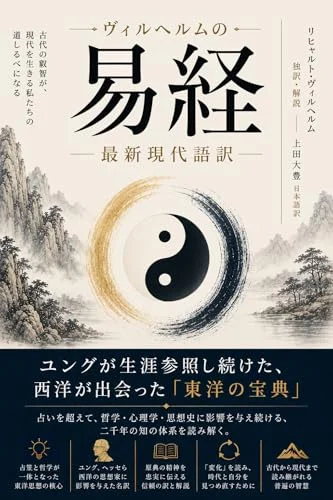
📖 The app translation is now a book
Free with Kindle Unlimited